Abductive strategy building beats hypothesis-testing (58)
 Kim Warren
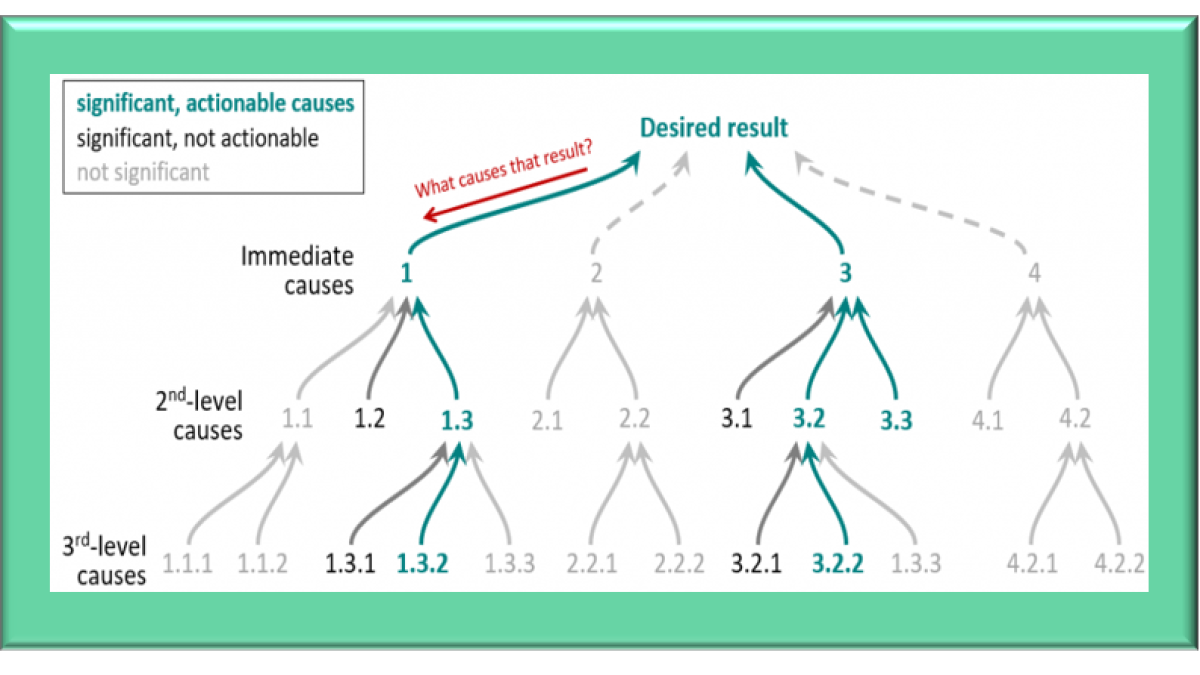
Like engineers, start from the end-result and test each possible explanation back to the root causes
My last post noted that hypothesis-testing is recommended as a scientific and efficient method for developing strategy – or maybe figuring out what’s going wrong. But that post also showed how it is not as efficient or reliable as is claimed.

Our course on how to build a digital-twin business
model follows the 'abductive' process in this post.
Coupon blog20 for 20% discount.
I also explained that, in business cases, we are not dealing with a vast, complex mystery in which thousands of unknown factors may be at work through thousands of unknown pathways – we are dealing with an almost-entirely known system that we ourselves designed.
Engineering – not science.
Think about a simple electronic circuit that’s not working. The engineer starts by testing the components that are most directly, proximally linked to the desired output. The signal into one of those will not be working, so they go on to test the next components down that path. The signal into one of those will not be working … and so the process goes on until the faulty component or link is found.
The parallel for us is to drill back from the outcome of concern, asking “What causes that?” Then repeat that question for each of those first answers, and so on …
To take a simple example from the Harvard Business School Online beginners guide to hypothesis-testing, we might have a hypothesis that “a marketing campaign will increase sales”.
So our approach starts by asking why are sales not increasing as we would like?
STEP 1. Sales = customers * sales/customer, so are sales not growing [a] because customer numbers are not growing, or [b] because sales/customer are not increasing? Next .. What causes each of these?
STEP 2a. Customer numbers tomorrow = customers now plus customers won minus customers lost, so are we winning new customers too slowly, or losing customers too fast?
STEP 2b. Sales/customer = purchase occasions * sales per occasion, so are customers not buying as often as they might, or are they buying less than they might on each occasion?
… and so on. So we will discover if our marketing campaign should [a] aim to win customers faster [b] keep customers from being lost (encourage loyalty) or [c] encourage more frequent purchases.
BEWARE – [1] there will be cross-links between items down this pyramid; e.g. poor service quality may be a next-level cause of both low purchase-rates and customer losses, and [2] those cross-links may feed back on themselves; e.g. customer-gains may harm service quality, which then slows those customer gains.
What we are doing here is working down this pyramid, not up it, and only following causal paths that evidence supports. We never followed paths 2 and 4 in the pyramid because items 2 and 4 were not proximate causes of the desired outcome.
Is this ‘abductive reasoning’? I know little about the philosophy of science, but as far as I can figure out, this seems to be a special case of “abductive reasoning” – what is the most likely explanation for the result?
It’s a special case, because we insist on chains of proximate causes; because both the result and its possible causes are quantified; because the dependency can be formulated.
Big advantages of the abductive method
- We do not need to ask all possible questions, and so analyse the whole pyramid. E.g. if customer numbers are rising, then we can ignore STEP 2a, and if we then find that customers are buying all they need on any occasion, we need only ask why they are not buying more often (they may choose competing products?)
- We don’t miss multiple explanations, as the hypothesis method did (root-cause 1.3.2 was not found in my previous post), because we keep asking “What causes that?’ along any path that continues to give a positive answer.
- Very many of the answers are simple arithmetic! We don’t rely on spurious ‘correlations’ between hypothetical root-causes and the desired outcome. Some causal links are not so simple, such as how much customers’ purchase rate will change for each $ of marketing, but those non-linear relationships are easily tested and expressed in ‘lookup’ form.
_____________
This abductive method is exactly how best to build digital-twin business models. Get the online course on how to do that here. Coupon blog20 gets followers a 20% discount.
Categories: : business modeling, related course, strategy