How to make SWOT strategy analysis useful – yes, really! (37)
 Kim Warren
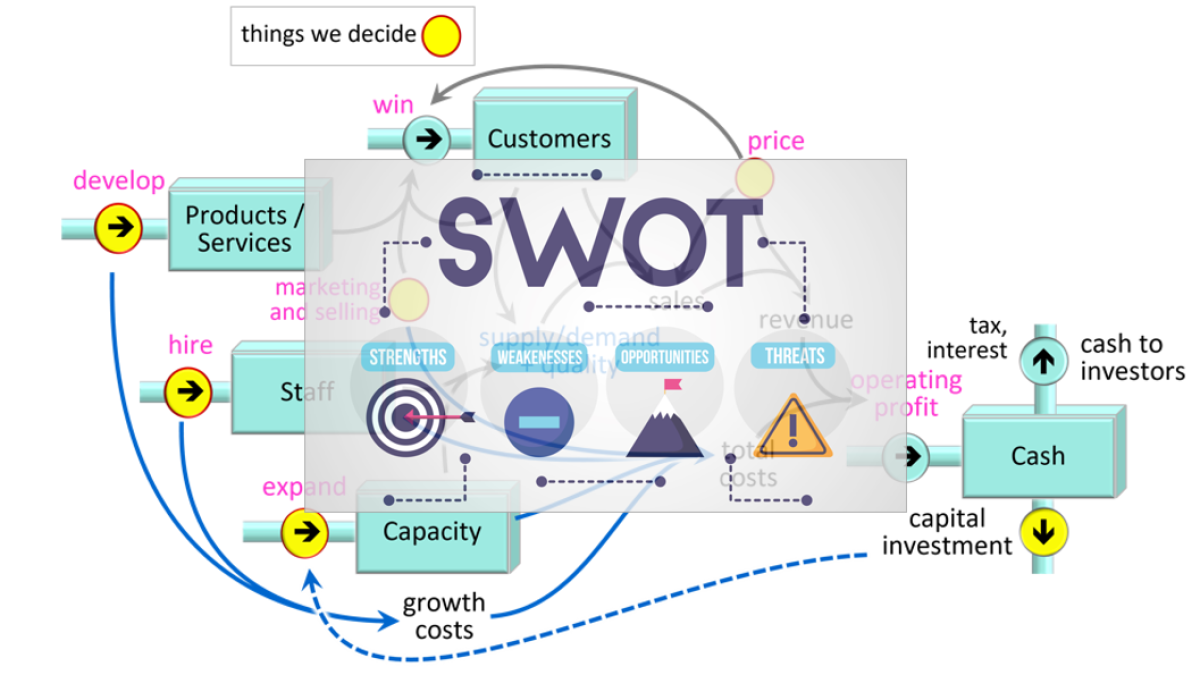
Digital-twin business models capture - with quantified precision - the strengths, weaknesses, opportunities and threats in our business system.
It probably dismays strategy academics and experts to know, as they surely do, that their deeply researched and sophisticated frameworks and methods are little used by real-world leadership teams.
Shockingly, one of the methods most used in practice is still SWOT analysis – an assessment of an organisation’s Strengths, Weaknesses, Opportunities and Threats! (A simple search on most-used strategy tools will find the top methods that expert sources say should be used. You have to hunt deeper to find what methods actually are used).
The better news is that SWOT can indeed be made more useful than its superficial results might suggest – surprisingly so! (Get my full article on this here)
Resources map onto strengths and weaknesses
We can upgrade what SWOT can do because there is a neat mapping of the resources and capabilities we define and exploit in the Strategy Dynamics method with the “strengths” of an organisation. From that foundation, the article goes on to show how:
- an organisation’s Strengths lie in the scale, quality and rate-of-change of its resources and capabilities (properly defined and quantified)
- Strengths and Weaknesses are not opposites – rather an organisation’s Strengths lie on a continuum, from low to high
- the degree of each Strength is best assessed relative to what is needed, what is possible, and what competitors may possess
- Opportunities are manifest in the scale and quality of potential resources and capabilities that might be developed
- Threats are not the opposite of Opportunities – rather, they are factors that may constrain our ability to build resources, or that may risk undermining our system by damaging our resources and capabilities
- It is possible, to build a timed action-plan from the assessed need and opportunity to build and protect the organisation’s resources and capabilities
- … and from there, realistic strategic objectives can be set, and plausible performance outcomes can be estimated
Figuring this out has been a substantial piece of work, and the full explanation is beyond the scope of a blog post. So instead, I have written it up in a 9-page article. You can download the article How to Make SWOT Analysis useful here.
____________
If you want to go further than SWOT can take you and develop a professional strategic plan, complete with adaptable implementation plans, see our Strategy for Leaders course.
Get ⅓ off the full price, using the coupon blog33 at checkout.
SWOT image courtesy of FreePik
Categories: : business models, strategy
Image by gstudioimagen on Freepik