Temporary staff – the fix that fails (02)
 Kim Warren

How excessive cost focus can overload staff, hitting productivity & profitability.

Get our course on the structures driving staffing dynamics.
Coupon blog20 for 20% discount.

Get the simple model of staff hiring and turnover explained in this post ...
A staffing crisis
UK friends will know that our beloved National Health Service (NHS) is in deep trouble, with staff shortages and high turnover across many of its medical professions. But there's a dysfunctional mechanism at work, making things still worse - a mechanism that afflicts many organisations, both business and non-commercial.
"Staff" of course are a critical resource in just about every part of every business. And like any resource, this one accumulates (with hiring) and depletes (with turnover, and maybe layoffs). The NHS has chronically under-hired for decades, so even with 'normal' turnover, numbers have never kept pace with rising demand.
The temporary staff fix
So what to do if you are in charge of a unit whose staff are struggling with a heavy over-load of work? ... bring in contract labour of course!
So you call one of the many agencies who employ and contract-out medical staff, notably nurses, but other professions too. Sure, that is much more costly per person-hour than what you pay employed staff, but at least you fixed the problem. And you can stop using agency staff when the workload eases - right?
The vicious cycle
Unfortunately, the workload does not ease, so you find yourself permanently employing agency staff. But it's what happens next that is the real problem ...
Your employed staff see that the agency staff are better paid, and have more flexible working. And they are not subject to the relentless on-going work pressure either. So employed staff leave for agency jobs, leaving the remaining staff under still more pressure and their managers still more reliant on costly agency staff.
WHY do we get in this mess?
The curse of financial controls
Now, other organisations may not get into quite such a contract-labour minefield as the NHS, but many struggle with over-loaded staff. Our obsession with %-profitability leads to cost controls, and staff are often a huge cost item, so we limit staffing to the bare minimum.
The resulting work overload hits performance, and drives up staff turnover, making the problem still worse. In business cases this often hits growth and retention of customers, so we get lower revenue growth and lower cash profit than we might have had.
Wider staffing challenges
Every organisation, of course, needs a long-term plan for staffing. But few appreciate just how complex and demanding such plans can be. Why?
- because the time-scales are so long (Want more nurses? then get them fully functioning 5 years from now)
- because the people in the system choose behaviours of their own, motivated by how they feel (like leaving to join agencies)
_____________
Here's a simple model showing how staff hiring and turnover interact to determine our success in building staff numbers. You can modify the model for your own use, or build it into larger models. Click the GIF to get the model.
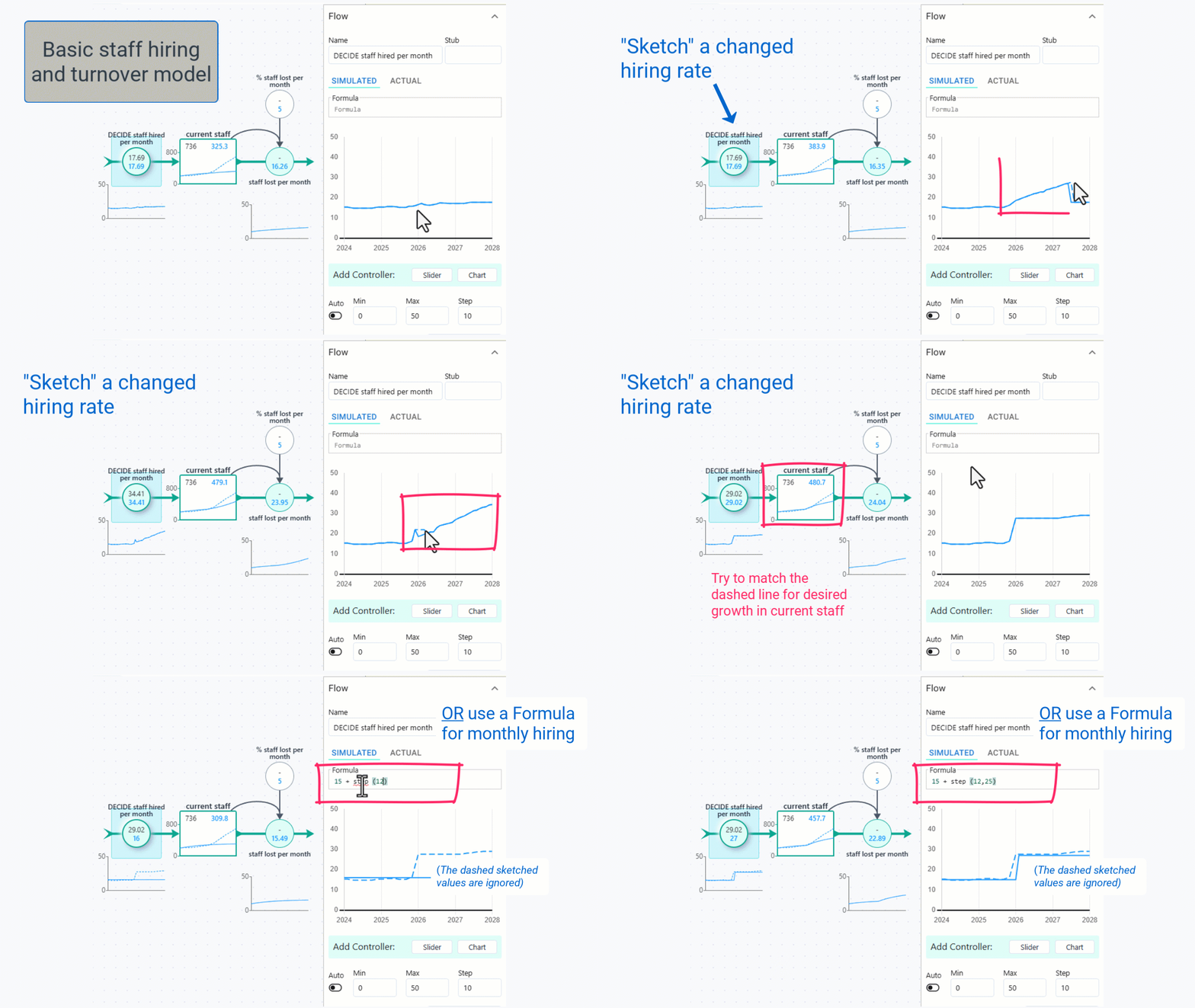
These are also known as 'digital twin' business models, because they capture the interactions and behaviour of all significant elements of a system, in this case the two levels of staff, and all hiring, promotion and turnover rates, and the factors motivating those rates.
___________
Learn how digital-twin models can help with all kinds of strategic HR challenges and planning in our short online course Dynamic Models for Strategic Human-Resource Management.
Categories: : model available, staffing & HR