The generic business architecture (47)
 Kim Warren

A small set of strategic resources (properly defined!) captures the core system driving any business
An earlier post explained that dynamic business models may feature common structures that arise in many different cases (e.g. how customers drive sales and how people-quality changes with staff movements).

Learn how to build digital-twin business models.
Coupon blog20 for 20% discount.
Generic structures for entire business types.
Now this claim may sound either trivial or not-credible, but it is neither of these – the principles really are as simple as I will explain, yet at the same time hugely powerful. The essential point is that:
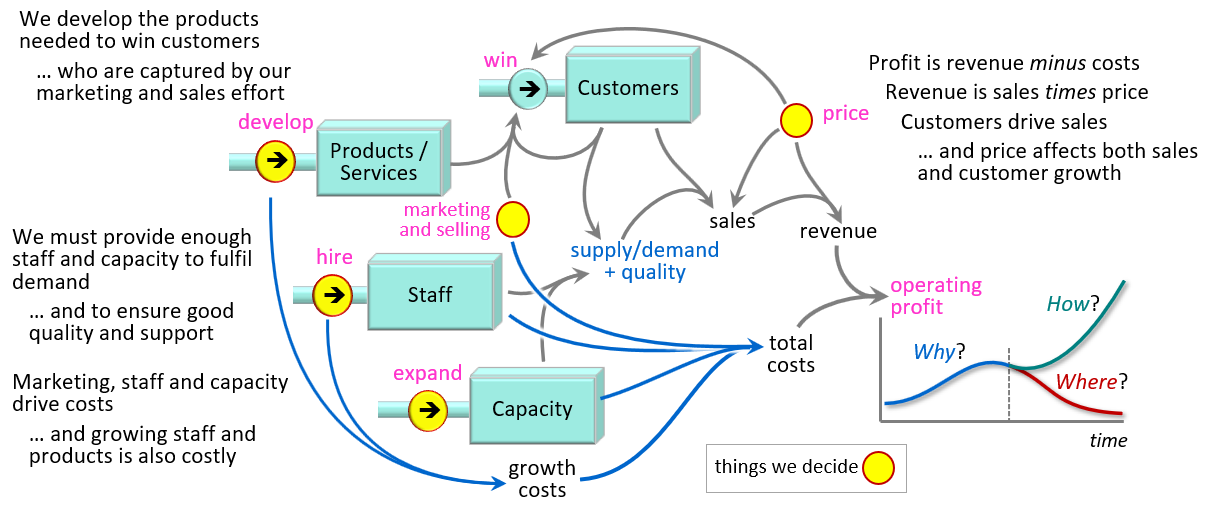
Every business operating in a sector is made up of the same few core resources, dependent on each other through the same causal mechanisms, and driving results in the same way.
This short video explains more.
Simple example 1 ..
Every local table-service restaurant in the world has customers who visit more or less often and drive meals-sold and revenue – they have staff to prepare and serve those meals – they have a product-range in the menu offered – they have capacity in the seats they provide and the cooking equipment – the food inputs they buy leave them with a gross profit on sales, and their staff and equipment drive operating costs.
The generic business architecture
Simple example 2 ..
Likewise, every producer of fast-moving consumer goods (FMCG) has a product range of brands, sells to store-owning customers, markets to consumers, has (or contracts-in) production capacity, and employs staff for selling and making products to satisfy demand.
Its revenue comes from sales volume of each product at the achieved prices. It incurs cost-of-materials to leave a gross profit. Its operating costs come from the staff it employs, equipment it operates and marketing spend.
So – pretty much every business has the standard resources – customers, products, staff, capacity and cash. (In the simple figure above, operating profit needs adjusting for non-cash items to get the cash in-flow)
Adjust and extend
We may need to make a few simple adjustments for any particular business type. Common examples:
- Firms buying inputs may need to deduct cost-of-goods from revenue to get their gross profit, from which operating costs are deducted to get their operating profit.
- Many types of business (like that FMCG example) may need to add intermediaries through which they sell to reach final customers.
And some business types may have 1-2 extra resources, like the order-book in ship building or land area for farming.
Then, you will likely want to do rather more than just the basic core model – like splitting out customer segments or staff groups, or capturing the trainees -> trained staff issue.
Or there may be extra features of your model, like take-out sales for the restaurant.
Nevertheless, what you have with a generic sector business model is a robust foundation for adding these extras – a reliable “theory” for how your business works!
BIIIIG advantages !!!
The existence of these standard business architectures is extremely helpful. It means that you can produce at least an initial model for any common business type from a generic sector-model.
Not only does that eliminate most of the effort in building that model, but it also means you can be sure the model is right (assuming the generic model was done by someone competent!)
________________
Our core course on building dynamic business models shows exactly how to follow these principles to build a working model of a simple business. Followers get a 20% saving – enter coupon ‘blog20‘ at checkout.
Categories: : business modeling, related course, strategy