The rigorous modeling process follows the Pyramid Principle (56)
 Kim Warren

The agile process for building a digital-twin business model follows exactly the Pyramid Principle : start from outcomes and work back.
My last post “Get buy-in with the Pyramid Principle” explained a process to win support for important conclusions or recommendations:
Start with the key recommendation, or issue you want agreed
... summarise the key insights that lead to this recommendation
... explain any supporting analysis that audience questions call for
The agile modeling process
I didn’t explicitly plan this, but it turns out that the rigorous ‘AgileSD’ process for building “digital twin” business models conforms with those same principles.

Get the course on how to build a digital-twin business model.
Coupon blog20 for 20% discount.
The agile modeling process.
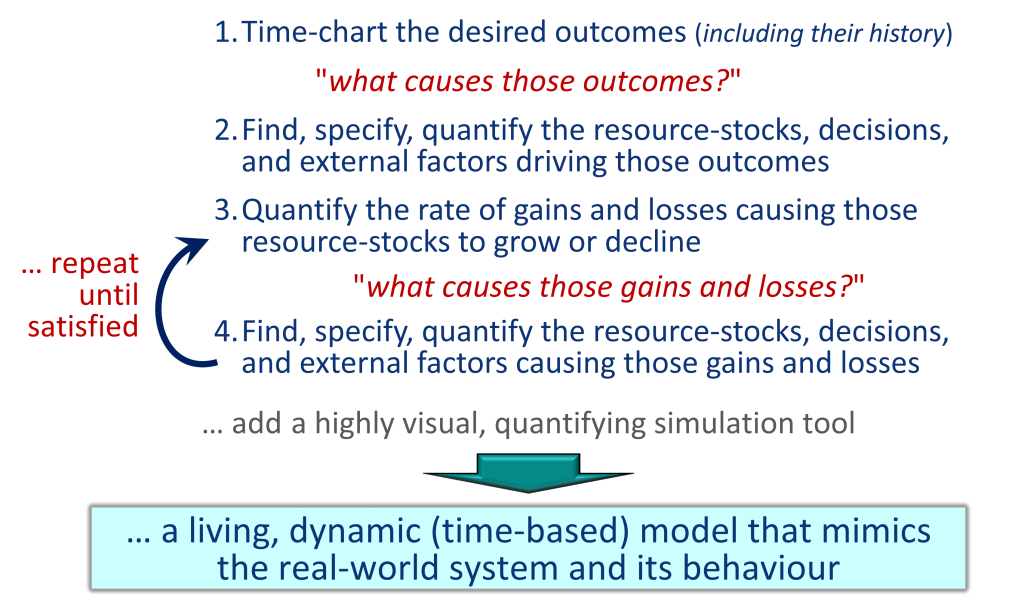
So step 1 is the top of the pyramid, steps 2-4 take you down to the first-level explanation, and repeating 2-4 gets you to the next level. You rarely need to repeat this more than twice.
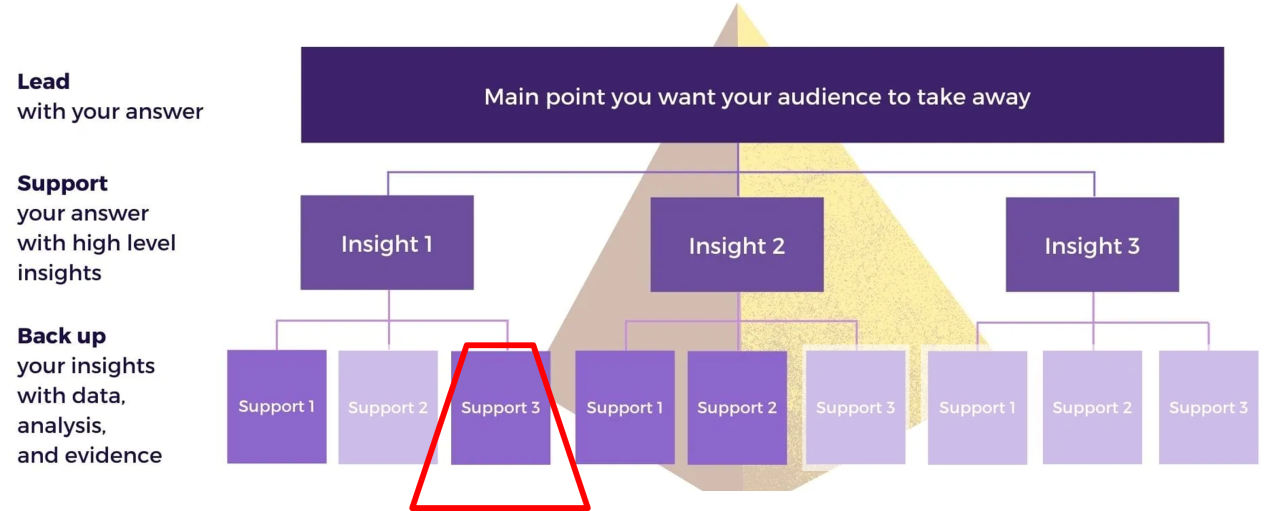
Resource stocks are critical
The only adjustment we are making to the general Pyramid Principle is that
Outcomes are always most directly explained by changing quantities of resource-stocks – customers, staff, etc.
... and those resource stocks are always and only explained by their own rates-of-change
So those stocks and their flows must feature in the 'key insights' level of the pyramid.
Simple example, "Sales are no longer growing (the key outcome finding), because customers have started to be lost, not because they are buying less (the key insight)"
Whatever the purpose
Whether creating a plan for a business or function; planning and managing a new initiative; fixing some problem – we start with a quantified chart of how the outcome of concern is changing over time.
That outcome can nearly always be directly calculated or estimated from very few proximate causes – sales = customers * sales/customer; service quality = a function of workload … so quantify those items too and formulate the relationship.
Keep pursuing that “what causes this?” process (including the bit about how “stocks” accumulate) until you have a good-enough explanation for the outcome. Where “good enough” means you can answer any likely question that your audience may ask.
There will be branches along the way, spreading out to cover the full scope of items needed to give an adequate explanation. And of course there will be interdependence and feedback among those connections (an issue that the Pyramid Principle itself does not recognise).
So … what we do in effective is to start at the top of the pyramid – drill down by asking “What causes that?” to generate a wider base to that pyramid – but we only widen the pyramid as much as is necessary to answer our needs.
_____________
Learn to use the agile method to build digital-twin business models in the online course "How to build a digital-twin business model". Followers get a 20% discount using coupon blog20 at checkout.
Categories: : business modeling, related course