Who causes recessions? - the business sector (74)
 Kim Warren
Economic downturns are not caused by cycles in final demand, but by boom and bust in industry investment. Here's why we do it.
Every economy seems to be cursed by economic cycles, with GDP racing ahead, only to fall back again. We can exploit the underlying causes for strategic success.
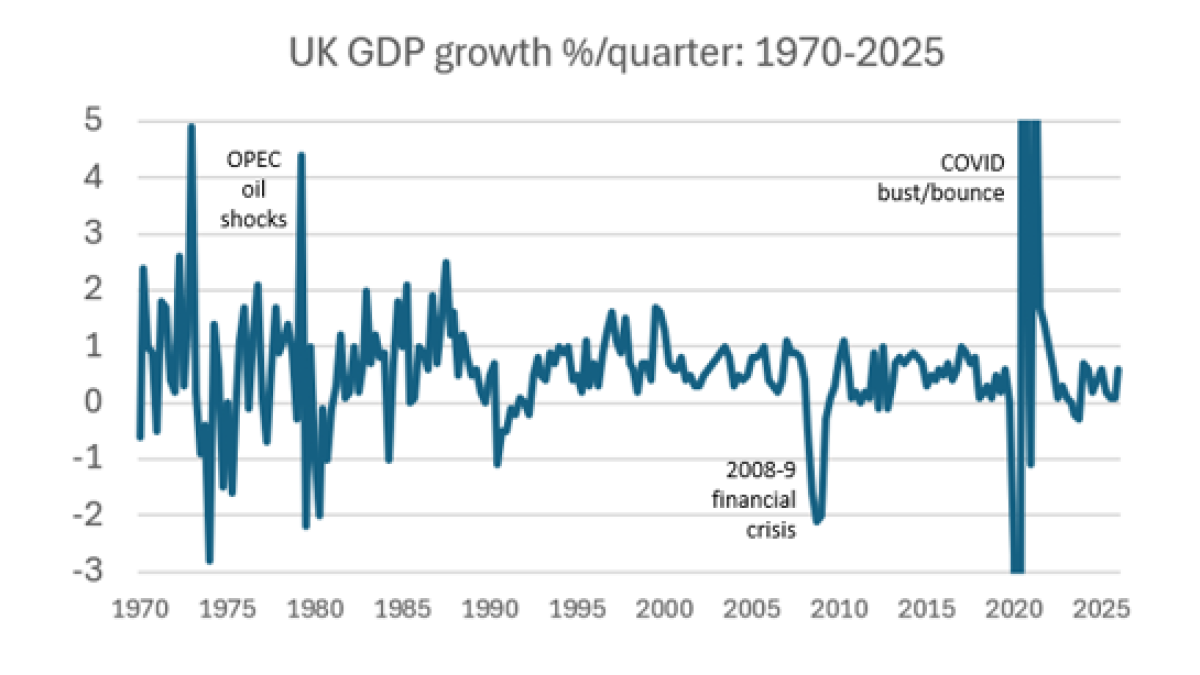
Here's the UK's experience.
Source: Office of National Statistics
UK followers may recall the prosperity of 1997-2007 – so good that Chancellor-Brown declared they had brought “an end to boom and bust”. Sadly, he – and we – were badly disappointed by the 2008 crisis, above!
Now as I understand it, GDP is made up of spending by households, government and business, +/- net imports. So if a recession is a fall in GDP, then one or more of those 3 groups must be cutting their spending. But which group kicks it off?
Business leaders like to believe that good times would continue to roll, if only they were not cursed by downturns in final demand, whether from households or government – not true!
Economic Contrarian Paul Ormerod has analysed the causes of economic recessions across hundreds of economies for the past 100+ years. And with few exceptions, the first sector to cut spending, and thus trigger a recession, is the corporate sector. (Exceptions are those down-turns triggered by wars, oil crises and, mostly lately, COVID).
Why business causes recessions
As far as I can follow, the explanation is something like this:
- While even modest economic growth continues, business enjoys good profitability, so their confidence leads them to invest (not just in capital projects, but in product development, hiring, marketing etc.) … and not just the businesses themselves but the banks who finance that expansion.
- Unfortunately, everyone shares that confidence – everyone anticipates good prospects – everyone thinks they can do better than average – so in total, they over-invest. If you added up the business plans of all companies in the sector, then the total forecast sales would far exceed any plausible sector growth.
- So business expansion leads to over-capacity, prices fall, profitability declines, so business cuts back on that over-spending, and businesses go bust. (Insolvencies surged in 2009, for example).
- This then cuts demand for other business sectors, who, as well as reigning back on their own excess growth, do indeed see a fall in demand.
- Jobs and/or real wages then fall, so then the household expenditure bit of GDP falls.
- Government tax revenue then falls and costs such as social support rise, so THEN the government bit of GDP falls.
- Eventually, supply and demand rebalance, businesses become profitable again, growth resumes, and the whole sorry saga starts all over again.
What’s this got to do with strategy?
Well, back in my early days in the field, we started strategic planning and budgeting by forecasting what might happen to market demand. Then we would set ambitions for our own growth and invest/spend accordingly. (Authoritative sources still suggest that approach, e.g. the McKinsey book on corporate valuation by Koller et al I’ve noted before here).
So if we can anticipate when the wheels may come off the economy, we may avoid exactly that over-expansion that everyone else is driving for, and save ourselves a lot of pain. This won’t be popular or easy of course – no-one likes to be told that the party may come to an end, and they won’t believe it in any case when all seems to be going so well.
But we can do much better than just avoid the pain of industry down-turns – we can exploit the insight to our own advantage … that’s for next time.
Categories: : business performance, finance, strategy