A much better strategic planning process (78)
 Kim Warren
Size the opportunity and what's needed to take it, then build the adaptable time-phased action plan - what to do, when, how much across the business.
I realise we should have laid out a robust process for developing and implementing the existing strategy before we talked last time (here) about extending that strategy.

Get the professional strategy and implementation course.
Coupon blog20 for 20% discount.
First, let’s kill the nonsense that strategic planning is pointless, because there’s too much uncertainty and things keep changing. Whenever we make a decision with consequences beyond the very near term, we must have some notion of likely outcomes in our head when we take that decision.
How can it possibly be better not to articulate that expectation than to do so?
Add the observation that successful companies don’t sit around passively reacting to whatever that horrible outside world throws at them – as Hamel & Prahalad so clearly explained in Competing for the Future. They create their own future. OK, so their examples are mega-corps, but the principles apply to all, albeit with less spectacular potential.
Yes, we do need ‘a forecast’
Whether we are after corporate backing for a business plan, seeking finance from outside investors, or simply reassuring the bank that our business is not heading for a cliff, we always need a forecast of likely performance. Of course that forecast will have many uncertainties, and of course the outcome will not match that forecast, so everyone knows the forecast will evolve – maybe even in a positive direction!
So – how to do that forecast? Here (highly summarised) is a typically recommended process*:
- forecast market growth
- set targets for market share to get a sales forecast
- forecast achievable prices to get a revenue forecast
- (if relevant) set targets for cost-of-goods to get a gross-profit forecast
- set targets for operating cost ratios as a % of revenue to get operating-cost forecasts
- subtract operating costs from revenue (or gross profit) for an operating profit forecast
There is so much wrong with this naïve approach that it’s not worth starting on, so let’s jump straight to something much better.
Size the opportunity, and what’s needed to grasp it
Here’s a process that [a] sizes the opportunity and speed it can be captured [b] sizes the supply-side of the business needed to take that opportunity, at that rate, and [c] sets out what to do, at what rate, to implement the strategy:
- How many potential additional customers could be captured, at what rate (whether totally new customers or from rivals)? What might their average purchase rate be? … gives us a sales forecast, provided we are also realistic about possible customer losses.
- How might the range and appeal of our products/services need to change in order to grow customers at that rate?
- How may our prices need to change in order to win and retain those customers at those rates? … which gives us a revenue forecast.
- … and how must marketing spend and sales effort change to win customers at that rate
- How must capacity grow (physical, logistical, IT and customer support) to fulfil the growing numbers of customers and the sales they generate?
- How fast must we grow staff numbers (of all skills) – and keep them – over time to build and operate the capacity, develop the products, win and support the customers?
- What will be the costs of growth, over time, for adding and improving products, hiring staff, adding capacity?
- What would be the costs of operating the changing scale of business – marketing, employing staff and operating the capacity? … total operating costs = current operating costs + costs of growth.
- … so how will operating profits grow, given the projected revenue and costs?
- … plus calculations of any related capital costs, depreciation, borrowing etc.
A timed action plan + constant revision
Since we now know the rate at which we have to do everything, both to develop and operate the business – hire staff, spend marketing, change prices, develop products …. – the process automatically generates the timed action-plan for each team.
… and because we scaled the growth of supply-side capacity (physical, logistical, IT and customer support) needed to support the growth of customers and sales, those team action-plans should already be ‘joined up‘. We don’t want to win customers who we can’t support, or capture sales that we can’t fulfil.
But this is where “... of course things will change” comes in … at least every quarter, or more frequently, we check all the rates of how things are actually changing against our latest expectation.
If the gap between actual and expected is not too great, we may only need to adjust the timed action-plan ... but if the gap starts to widen, we may need to go back to the start and repeat the process.
Why this process works …
What we are doing with this process is recognising the system structure of the underlying ‘stuff’ that makes the business function. Then we are working our way logically around that system to get the rate at which all of its elements can, or need to, develop. (Hence the distinction above between business-as-usual costs and business growth costs).
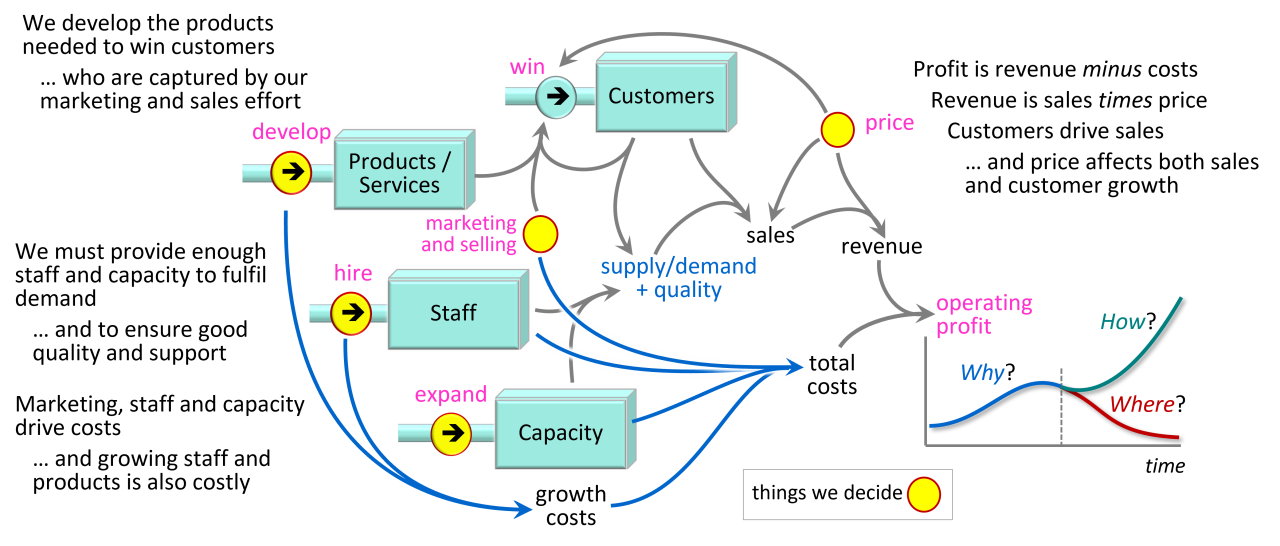
(This minimal structure may be extended, e.g. to include cost-of-goods and intermediaries, and can be ‘multiplied’ to capture multiple business units, segments, regions etc)
What we are not doing is
- projecting revenue growth with no clue where it will come from, and
- projecting future costs with no reference to what is needed to actually deliver those revenues.
____________
* This is how, for example, the McKinsey finance bible recommends we forecast performance (Koller et al, "Valuation: Measuring and Managing the Value of Companies") - a great book on everything else, but not this!
Categories: : related course, strategy