Extend your strategy - don't re-invent it (77)
 Kim Warren
Successful firms don't keep changing their minds, but they do develop and extend their strategy. Here's how ...
I have made the case before that successful companies do not keep changing their mind about what they do (See Strategy is more than ‘position’).

Get our professional course on strategy and implementation.
Coupon blog20 for 20% discount.
What follows is intentionally explained with simple, familiar examples, but applies equally to more complex contexts, from online services to media to B2B – even to public services and non-profit settings. It is a useful exercise to try applying the principles to well-known cases. Don’t forget to consider the scale of additional opportunity that any such strategy extension might offer.
Some companies never significantly change their position – IKEA furniture retailer or low-fare airline Ryanair, for example. Their core ‘position’ is virtually identical to where they started decades ago.
However, most businesses do at least evolve their strategic position …
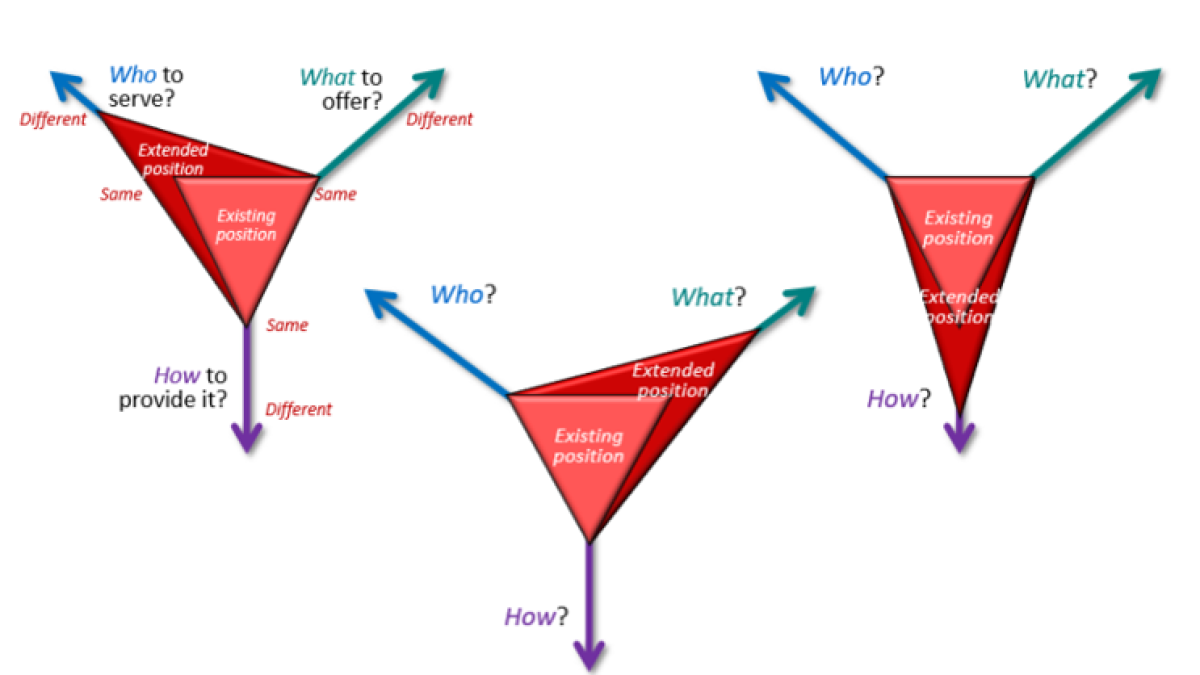
Your Who, What, How? position
A simple way to summarise that choice of strategic position is to specify who we aim to serve (the target customer types), what we can offer that they might want to buy (exactly what products or services), and how we will provide them with what they want.
There’s a lot to this last ‘how’ dimension, covering everything on the supply-side of the business, right from sourcing the inputs, creating the products/services, and fulfilling customer demand. (I’ve noted before how common strategy frameworks badly neglect the extent and complexity of that supply-side.)
Here’s a simplified outline of IKEA’s strategic position (a full spec would be much more substantial and link to quantified definitions of target customer-segments, product range, supplier numbers and types, and so on … )
IKEA’s summary strategic position
Who? Cost-conscious couples and families
What? Robust, affordable furniture and essential household durables.
How? Out-sourced, tightly-controlled manufacture
– very large self-service stores (and more …)
Why extend the strategic position?
Pursuing a strategic position over many years may play out in several ways:
- It may have such great potential, and face such limited competition – as in IKEA’s case – that the business can simply continue developing and enjoying ever-growing cash flows for decades.
- … or the position may reach a saturation point where the potential has largely been exploited – as many other retailers have discovered (fashion chains, coffee-stores, cinemas …) – so growth and cash flow stall.
- … or the position may become unviable where nobody wants the product or service – as Kodak discovered in photo-film – so the business dies.
I guess the most widespread scenario is the middle case, where we enjoy successful business development and growing cash flows for many years, but then run out of road to build it further, because we and competitors have used up the opportunity.

If we run out of road, we can go back to the 3-part position and look for ways to extend the strategy by adding to one or more of those dimensions:
Who we serve? We might seek new potential customer segments. IKEA long ago started targeting business customers as well as consumers, for example. In a B2B setting, many business consulting firms have found that their capability – with some modification – could give them access to potential public sector clients.
What we offer? IKEA has done little on this dimension, but retailers often extend their product range to capture added revenue from existing customers. And of course, software providers, social media and others are for ever adding features to boost customer usage.
How we do it? Again, IKEA has done little to extend how it operates – it even lacks much of an online sales channel. But in different case, coffee-store chain Costa added self-service machines in non-Costa premises. These give it access to the same customers with the same product, but through more ‘points of presence’ – and so captures more purchase needs and events.
Further issues …
- These strategy extensions only give access to potential new sales – we still have to do the work to get those customers (existing or new) to adopt the proposition. (See the choice pipeline.)
- Extending what we offer also often extends who we can serve – those new features offered by software and social media firms, for example, may both boost usage by the ‘same’ customers as well as appealing to new, ‘different’ customers.
- All such strategy extensions on the demand-side of the business impose requirements for extensions on the supply-side – more/different staff, types of capacity, support systems etc.
- So beware! – the more ‘different’ is the new position, the more radical is the extension of the strategy, and the more challenging it is to achieve.
- Sometimes, the extension to the strategic position is so successful that the previously ‘existing’ position is abandoned, e.g. selling direct to end-consumers, rather than through intermediaries.
Categories: : related course, marketing & sales, strategy