How to win - big-time - in a falling market (17)
 Kim Warren

We'd all love to build a business in a growing market, right? But you can grow a business and cash flow in falling markets too.
There's money to be made in declining markets - especially if you can exploit rivals who don't understand what you do ...

Learn how competition truly works
and how to win. Coupon blog20 for 20% discount.
We all love growth markets, right? Ever-growing customer numbers, rising sales and revenues - what's not to like?
Well, first, you are likely not the only one to be charging ahead, creating products, fighting for customers, building capacity and staff ... and all that is costly! Which can mean many years of negative cash flow for many companies who pile into the gold rush. And as the winners pull ahead, the also-rans struggle or die.
Just count the cash flow in mature markets
But when an industry matures, the need for expensive investment slows down. Sure, you may have to keep your products fresh, but much of that costly investment can slow. So you are left with a nice stable business, generating reliable revenues. And with competitors understanding each other, profitability is OK and your business just keeps producing cash. (None of this is quite as easy or guaranteed is this suggests, of course, but you get the idea)
And you can keep making money in declining markets
A friend was owner-president of a regional distributor for heating, ventilation and air-con equipment (HVAC). For decades, his business and local rivals had enjoyed growing sales and profits as more and more households and companies upgraded their properties.
But then everyone noticed sales were slipping, across the regional market.
Others in the industry association mostly agreed that this was just a blip in the housing cycle, and things would return to normal. But my friend was not so sure.
He modeled out how updated HVAC had been penetrating the real-estate in the region. (Yes, a company president building a model!). He saw that the pool of potential customers was drying up ... which meant that new-equipment sales would inevitably slow for many years - at least until the next innovation showed up. (This would turn out to be solar-PV, batteries and heat-pumps).
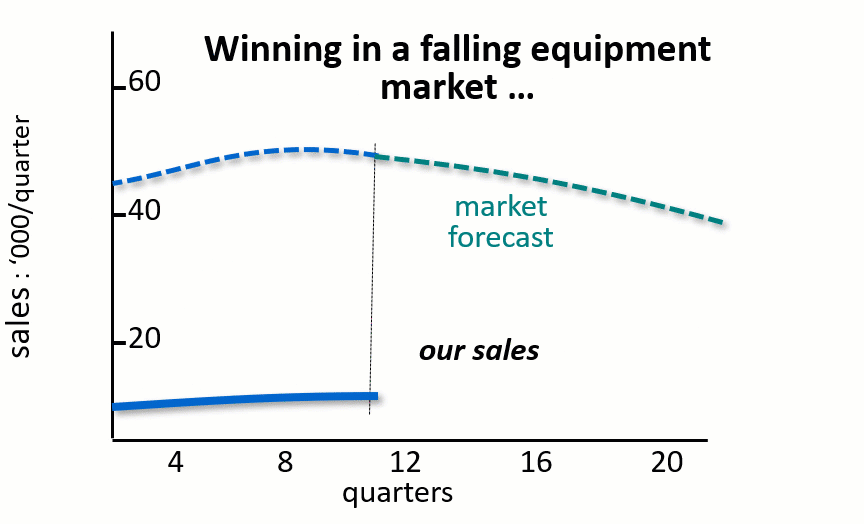
Oh no! - What to do? My friend's model suggested that, if he continued business-as-usual, sales and revenues would decline. The falling gross profit from those sales would soon dip below his operating costs (largely staff) and he could go out of business.
So he 'right-sized' the business, reducing staff in the sales and installations teams, but leaving enough to continue supporting property-owners' demand for maintenance and repairs. And with lower new-sales opportunities, he saved on inventory, space and overhead costs too.
"Let me help you competitors out of your troubles"
Competitors were not so smart. So one by one, they got into financial difficulties and they started to fold.
My friend was able to "help them out", picking up the useful remnants of their operations, but at fire-sale prices! Now, although new-equipment sales may have fallen back, demand had not died completely. So his reduced-scale business actually grew, both in revenues and profits, while others were failing.
Two pieces of general learning from this story:
- Yes you can thrive when your market environment worsens. And that's not just when - like here - there's a systemic shift. There may be times, such as in economic recessions, when any sector slips back, leaving over-enthusiastic companies high and dry. And if you are smarter, you can exploit that situation.
- And, yes, a digital twin business model can play out just how that future will likely unfold. And you can use that model to rehearse how you can win, and then use that same model to manage that strategy, from week to week.
_______________
Why not get these useful blog posts before anyone else. Subscribe to my "value email newsletter" - and get a free article on strategy implementation too.
Building a digital-twin business model is nothing like as complicated as you may think - it's actually easier, faster and less error-prone than building a spreadsheet model for the same purpose. See our course "How to build a digital-twin business model" … coupon blog20 gets followers a 20% discount.
Categories: : business modeling, business performance, competition, related course, strategy