It's cash (or lack of!) that kills business, not profitability (86)
 Kim Warren
Economists may think profitability drives business failure, but owners often want to hold on – until the banks say 'No!'
Some time ago I was involved in helping explain to UK local authorities the drivers of change to supply and demand for elderly-care homes. This was to help them understand the likely prices they would have to pay providers in order to ensure enough capacity. (In the UK, those authorities are fully responsible for ensuring that vulnerable elderly people are cared for, mostly through commercial care homes operated mostly by small and large multi-unit companies)

This model shows how investment delays
cause cyclicality in another type of case.
Elderly care - a cyclical industry!
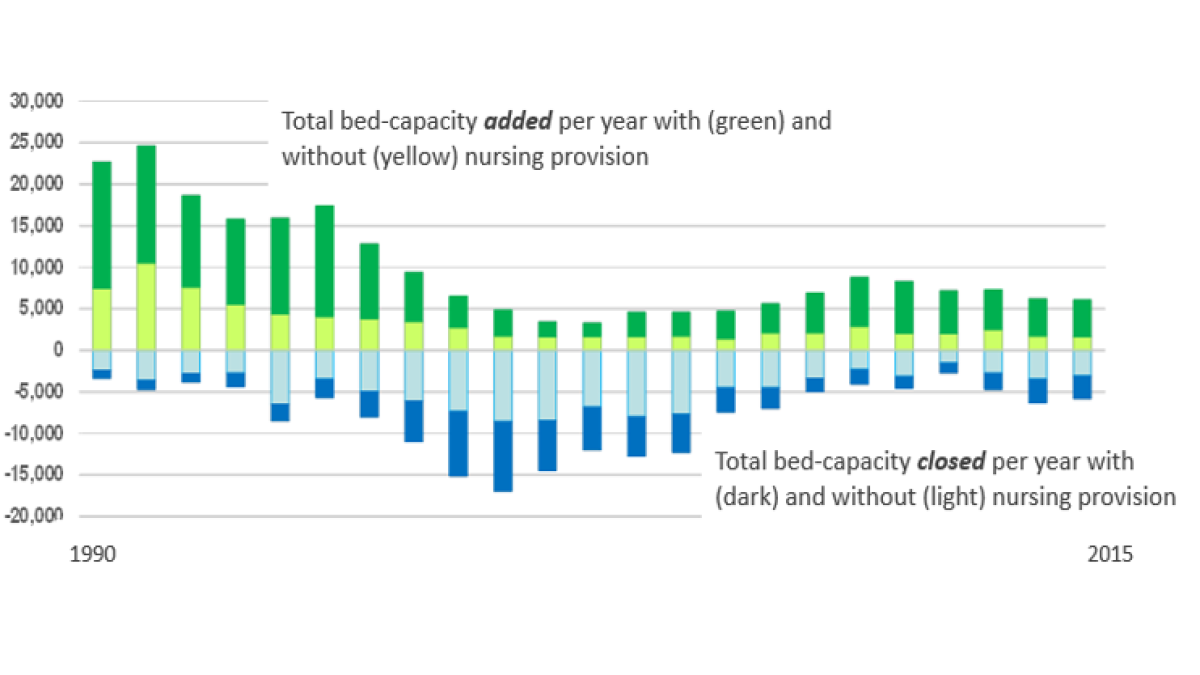
It may be a surprise to learn that this elderly-care industry was cyclical, going through periods of 'boom' when providers built new homes, and 'bust' when homes closed down. This was for exactly the same reasons that apply in other industries (explained previously here)
- new capacity was built when there was a shortage and it looked financially attractive for providers to expand
- that expansion led to over-capacity - so profitability fell, leading to the less-viable homes closing- mostly smaller, privately operated units
- ... which led once more to shortages and improved profitability, so new home-building started again
The team I helped was led by an economist with great experience in how the elderly care market works, and he asked me to build a dynamic model that could be populated - for any authority's geographic area - with detailed data on numbers and sizes of care homes, demand (how many people needed a room in care), prices, and profitability. The team had detailed profitability models for different sizes and types of care home, so we had all the data we needed to build accurate models and validate them against each authority's historic evidence.

CASH (or debt!) - killed the care homes
We found, for every authority area we looked at, that the rate of new homes opening in any year was well-explained by good average profitability for existing care homes some 2-3 years previously. The delay reflected the construction time - if a company's homes are profitable today, it works to develop another which will open some time later.
The project got stuck, however, when we tried to explain the timing of care home closures. Being an economist, the team leader was adamant that this closure rate would also be explained by the profitability of existing homes - the business fails when profit goes substantially negative, right?
But the data didn't fit that explanation. And it soon became clear why.
Whether run by private operators or larger companies, care homes could keep running at a loss for some years. But their cash was running down and/or their debts were building up. They hit the wall and had to close when the level of those debts became intolerable to their lenders.
Why does this matter, and what to do?
This matters at an industry level because it extends the period of over-capacity, and therefore the length of time when everyone is suffering poor profitability - even the stronger players who will survive. And that matters to the wider economy because it extends the time during which, for example, workers are laid off and tax receipts are depressed.
And it is important for the strategies of stronger firms. I explained in a previous post on cyclicality that smart operators exploit the 'bust' in an industry by buying up bankrupt operators and closing down non-viable capacity. The faster they can do that, the sooner the industry down-turn will end and the sooner their own business will return to profitability.
Categories: : business performance, finance, model available, strategy