Strategy in asset-intensive industries where growth may not be an option (76)
 Kim Warren
Utilities and other asset-intensive industries can offer limited growth, but strategy is still critical – keep those assets in good shape!
In today’s digital-obsessed world, it’s easy to forget that we still rely heavily on many boring old asset-intensive industries – power, water and other utilities, of course, but also public infrastructure, transportation, and many manufacturing sectors.

Get the asset-pipeline strategy model.
And it’s not hard to find cases where strategy has gone badly wrong for such asset-intensive organisations. UK followers will be only too familiar with the bad consequences of inadequate and degraded water-treatment facilities. Other countries, too, have seen the problems of under-maintained utilities and public infrastructure. Less visible, but no less problematic, are the corporate failures that follow from pernicious long-term under-investment in maintaining and replacing degrading assets.
Why do we let it happen?
It’s not hard to see how these problems emerge. Physical equipment is costly! So delivering a strong return on invested capital naturally motivates a wish to limit that investment. And public sector cases, too, face constraints on government funding.
But other factors exacerbate the problem:
- Many of these sectors are mature, with low levels of profitability, so struggle to generate the cash to finance replacement assets, or to afford the borrowing to finance that capital expenditure (CAPEX). (See my post on the financial value of strategy)
- Many such sectors are also low-growth, so with little prospect of driving shareholder value by building cash flows through sales growth, management has little option but to press down on operating expenditure (OPEX).
- And with rather limited expenditure being needed for growth drivers, like product development or marketing and sales, maintenance expenditure becomes a large fraction of operating costs, and thus a target for savings to boost cash flow.
- The fact that the degradation of those assets can be slow is – paradoxically – unhelpful. Whether deciding on CAPEX or OPEX, we can always defer necessary spending. Surely that old piece of kit can go on another few years – surely a bit less maintenance won’t do too much harm?
The degrading asset pipeline
Of course, physical assets constitute a resource, or “stock”, in the business system – a quantity of something that is added-to or depleted over time. And like other resource stock, these too move through a pipeline of states. (See my post on the generic strategic business architecture)
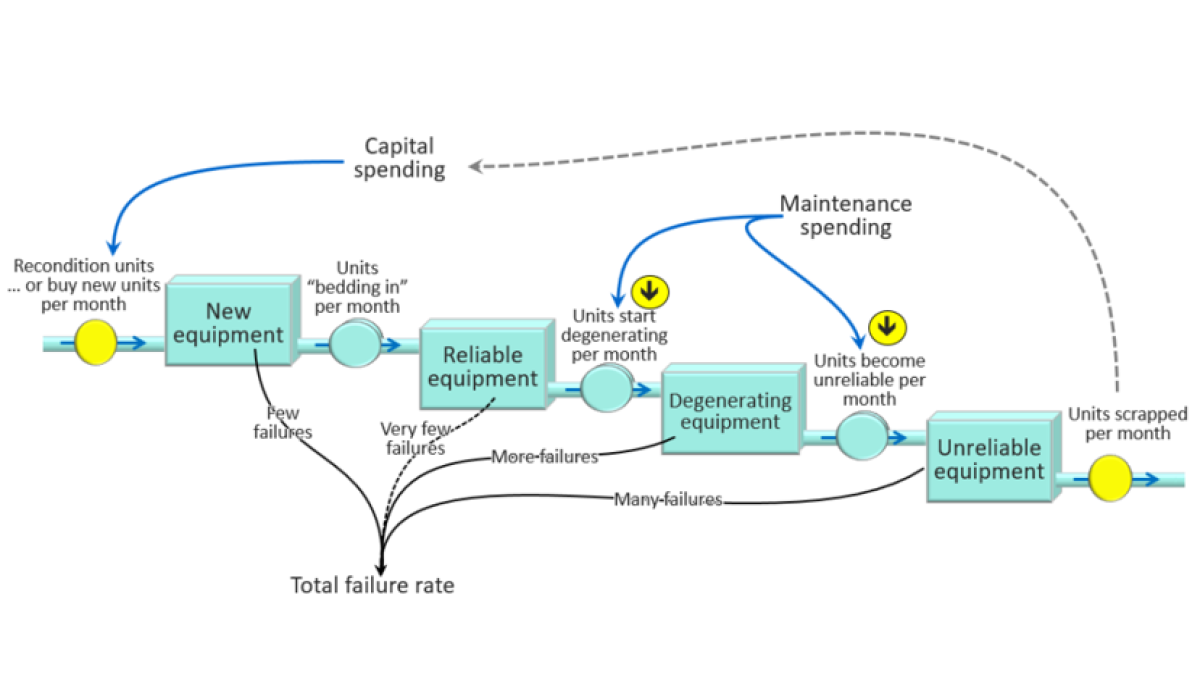
However, while the pipelines for product development, winning customers, and staff development capture improving states for those resources, the asset pipeline is about degradation. Take a water distribution business, for example. (You can also imagine how these states apply to a motor vehicle!) :

- New assets may give a few problems in the first year, but generally cause few failures.
- Assets then start a long reliable life – sometimes decades! – when they cause very few failures.
- Assets then spend another long period in a degenerated state, when parts are wear out and cause a higher failure rate.
- Lastly, assets are so degraded that they are quite unreliable and cause frequent failures
So the total failure rate of the system – which is of course also costly – is the sum of the failure rates of assets in each state. The decisions that determine assets’ movement through this system are highlighted in this figure.
The asset strategy
Now, with very little opportunity for business development, “strategy” in such cases is dominated by the strategic management of those assets. And that is essentially about two critical spending rates.
How much CAPEX to spend each year on scrapping and replacing unreliable assets, or possibly taking assets temporarily out of use for reconditioning.
How much OPEX to spend each year on maintenance – and on which class of assets.
Here is a scenario that plays out – initially – what could be the history of many public utilities in many countries. The business is privatised in 2005, and management immediately starts delivering shareholder value by boosting cash flow through cutting both OPEX and CAPEX. Each year, though, the rate of system failures rises – not steeply on an annual view, but cumulatively by a large fraction. (This process would likely be more gradual, of course).
The period from 2015 shows just how big is the challenge to recover the dire state of the system from that time – at least 10 years of heavily negative cash flow, just to get back to where we started!

Still – at least investors, and management, pocketed a load of cash while the users of the system suffered ever-worsening service.
Categories: : business performance, finance, model available, operations, strategy