Strategy: Position–Implementation–Operations (73)
 Kim Warren
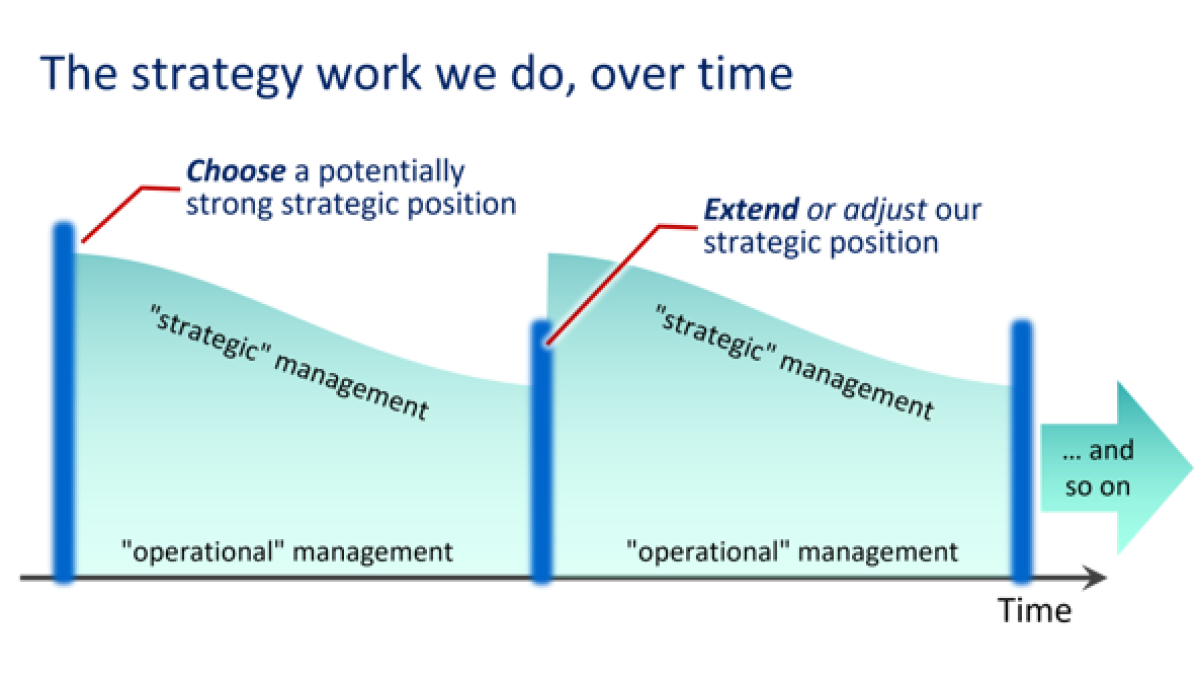
The connection between big, one-off choices and making things happen. How strategy work changes continually over time.
You probably know by now that I put a very big importance on the language we use – if we are not clear exactly what it is of which we speak, then confusion and failure will likely follow. (You will also know my view that putting numbers on those things helps drive out such confusion).

Get our full course on strategy & implementation.
There's a low-cost option. Coupon blog20 for 20% discount.
Let me summarise the key terms I use for strategy-relevant activities:
- The word “strategic” means “having a significant effect on the medium- to long-term outcomes for the organisation’s performance aims“. And to encompass public policy and non-profit contexts, those aims may include financial and/or other outcomes.
- Choosing our strategic position or “where to compete” – who we aim to serve, with what products/services, and how. An important but very infrequent task.
- Strategy Implementation – the continuing stream of decisions, activities and initiatives that we know to have a significant impact on medium- to long-term performance.
- Business operations – the continuing routine things we do simply to make the business work. These can unintentionally impact on that strategic performance (often badly!).
A little history (sorry) … “Strategy” was the big topic in business schools in the 1990s, when it emerged from the previous flaky notion of “business policy”. That happened when economists led by Harvard’s Michael Porter reversed the concern of competition policy (how to stop companies extracting excessive profit by stifling competition) to answer the question “How can a company manage competitive forces to achieve sustained, superior profitability?” (Set aside for now that investors value growth in free cash flow, not profitability! See my post on The financial value of strategy)
Strategy -v- “operations”
Throughout the 90s and noughties, this competitive forces insight was seen as a blinding light of clarity in the previously foggy world of “business policy”. But it was taken way too far – all that Strategy needed to do, we were told, was to pick a strategic “position” – who exactly to serve, with what, and how – where you could control those competitive forces limiting your profitability, and you would be guaranteed “sustainable competitive advantage” and superior profitability.
Everything else, Porter and others claimed, was merely [sic] “operations” and not an issue for serious strategy folk to concern themselves with. (As it happens, the business-school strategy folk soon discovered that what companies actually do was more important to profitability than choice of position. Translation … we can deliver huge cash-flows in competitively tough industries, and mess up all on our own in benign settings!)
Two problems with the strategy/operations dichotomy:
- Choosing or changing a strategic position is a very rare event – successful companies do not keep changing their mind about what they do ! … though they may extend that ambition, or adjust if things change.
- If that is all that strategy requires, then those ‘operational’ decisions and actions must include big initiatives – even seemingly minor decisions – that can completely destroy any chance of achieving or holding that strong strategic position … very fast, and at any time.
(See my post “Position” is not Strategy)
How strategy work changes over time
This extreme dichotomy between Strategy and Operations is totally unhelpful (and in fact unrealistic!). Because what sits between these extremes is the strategic management that leaders undertake, continually. So the mix of strategically important work that we do over time changes something like this …

A few things about this picture …
- Yes, there is significant work to do in choosing, specifying and adjusting our strategic position, but that work is very infrequent.
- The strategic management work we do – planning and undertaking big initiatives, dealing with competitive opportunities and threats, etc. – is continuous and very substantial.
- That strategic management work is especially critical soon after choosing or adjusting the strategic position – developing new product/service lines, building new capabilities, making acquisitions, etc – but continues, substantially, thereafter.
- There is no hard distinction between strategic management and operational management – it is a continuum, with some decisions/actions being more or less strategically significant than others. And a seemingly minor operational decision or action can have unforeseen and major consequences for the organisation’s future success. (See a previous post on how a minor hiring decision destroyed a new-sector strategy for an insurance company.)
- All that work that happens between position-choice episodes is how we implement the strategy – a topic badly served by what are still the dominant paradigms in the strategic management field.
What do YOU think?
All this is just my best effort to make the most rigorous but practical sense out of what – it has to be said – is the widespread mess and confusion about the language of real-world strategy, both for business and non-commercial cases.
But maybe I am wrong? Is my critique of the strategy field and its language faulty? Is there some other language-set and concepts that better describe how strategy is best understood and implemented?
Do let me know – contact@strategydynamics.com. And please share this post with others who may have relevant experience and expertise.
Categories: : course available, strategy