Extend your strategy? Extend and test the digital twin business model (80)
 Kim Warren
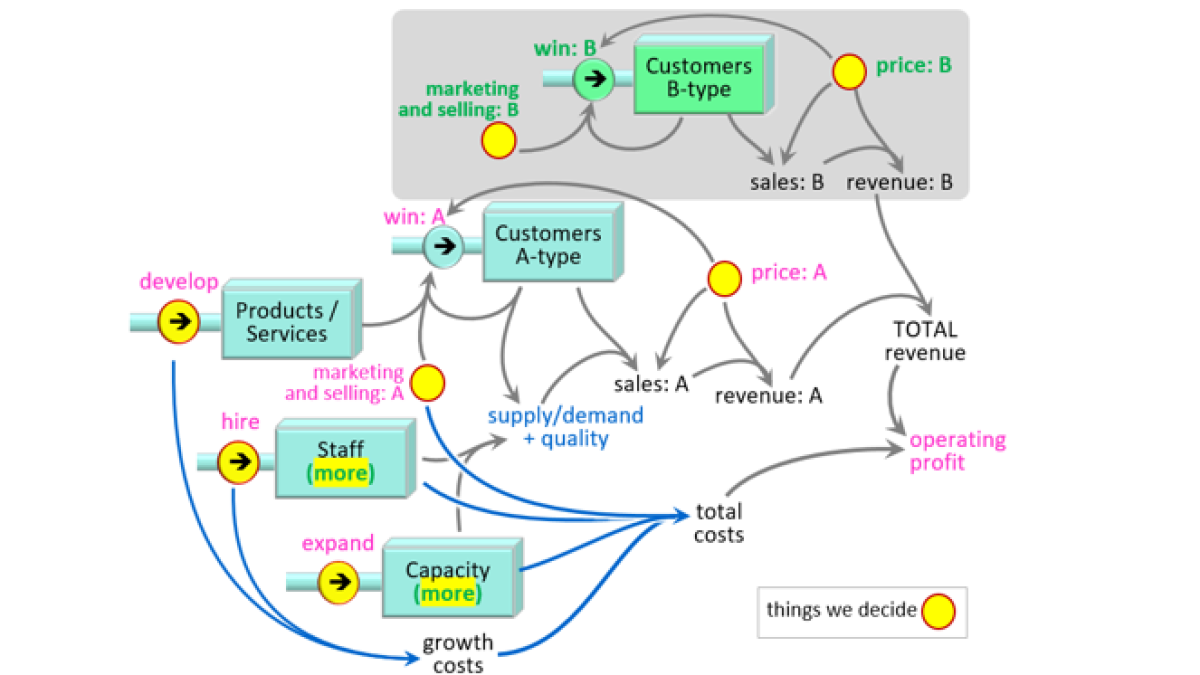
Our digital-twin business model explains and predicts how our business works and performs – so adapt the model for how the strategy may be extended.
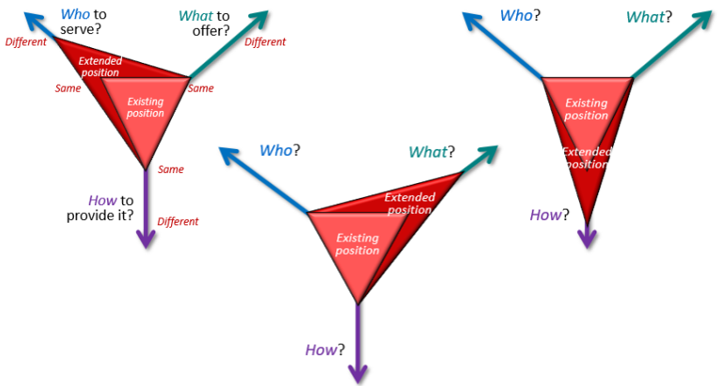
I previously offered here this framework for working out the nature and scale of opportunities to extend our strategy – adding to the types of customer we serve (who), and/or the types of products/services we offer (what), and/or adding a new way of operating (how) …
We should surely test our strategy – whether that’s business-as-usual or any change to that BAU – yes? And we should certainly test this extended strategy before risking cash or effort on doing it!
Get our course on building digital-twin business models.
Coupon blog20 for 20% discount.
I have also explained here how spreadsheets are hopelessly unfit for this purpose. So instead we need a digital-twin business model.
Extend the strategy – extend the system
The strategy dynamics method leads to a high level structure for how standard resources properly specified (customers, staff, product-range, capacity + some context-specific items) work together in a generic “strategic architecture” to drive sales and profits (if you need a reminder, start here).
So … extending the strategy implies one or more of the following:
- winning a population of new-type customers – e.g. if we already serve consumers, maybe start to serve small enterprises (quite different from simply capturing more customers into the same stock)
- building a set of new-type products – e.g. if we already offer physical products, maybe start to offer parts for self-assembly (quite different from simply adding more products to the existing range)
- building whatever other resources are needed to enable a new way of operating – e.g. building an online store if we currently sell only through retailers
… so extend the model
The way we handle this in a working digital-twin business model is not technically difficult. Take a case where we ‘extend’ by adding small business customers to our current consumer focus.
- Add a distinct stock for those new-type customers, e.g. change the name of our ‘Customers’ stock to ‘Consumers’ and add a 2nd stock of ‘Business customers’
- Add any elements required to build that new stock, e.g. new marketing spend, different pricing
- Add whatever elements and connections are needed to capture how the added stock interacts with the rest of the existing system e.g. if we add new-type customers, we may need to add the support-demand they create, and of course the sales and revenue they generate, and of course, the impact on sales and profits.
Here is a high level summary of the model structure you would end up with, where we are adding B-type customers to a business already serving A-type customers …

Note that there’s detail inside the ‘supply/demand quality’ element, e.g. if we add a whole new customer group, we would likely need more capacity to fulfil the added demand, and more staff to support those customers.
If we were, instead, to extend by adding a new product category, then we would duplicate the upper-left section of the model. But this, too, implies additional marketing/selling, a distinct price/sales/revenue section, and once again a need for more staff and capacity.
Categories: : business modeling, related course, strategy