Planning and managing performance improvement programs (60)
 Kim Warren
Performance improvement programs often fail. But finding and taking early successes can sustain the momentum.
Organisations undertake many kinds of performance improvement programs (PIP), from raising energy efficiency to improving health and safety to increasing data security. A hot PIP topic right now, of course, is the deployment of agentic AI to improve business effectiveness at radically lower cost.

Get our course on planning and managing PIPs.
Coupon blog20 for 20% discount.

Get the model of a performance improvement program.
Example: Net Zero programs for SMEs
Small and medium enterprises (SMEs) account for a large fraction of greenhouse-gas emissions (GHGs) from the business sector. But few appreciate the huge scope that exists to do this in most cases, or the large cost savings they would enjoy from doing so. (A 40% saving over 2 years is not uncommon).
Furthermore, most SMEs have little awareness of how to plan and implement a program to cut their emissions.
The British Standards Institution (BSI) publishes ISO management standards that help plan and implement a vast range of performance improvement initiatives, including some focused on measuring and cutting GHG emissions. BSI asked us to build an engaging game to give SME owners and leaders a sense of what might be possible, and how an emission-reduction program could play out.

Click the image to play the game >>>
How does the game work? … and indeed how do real-world programs to cut energy-use and GHG emissions work?
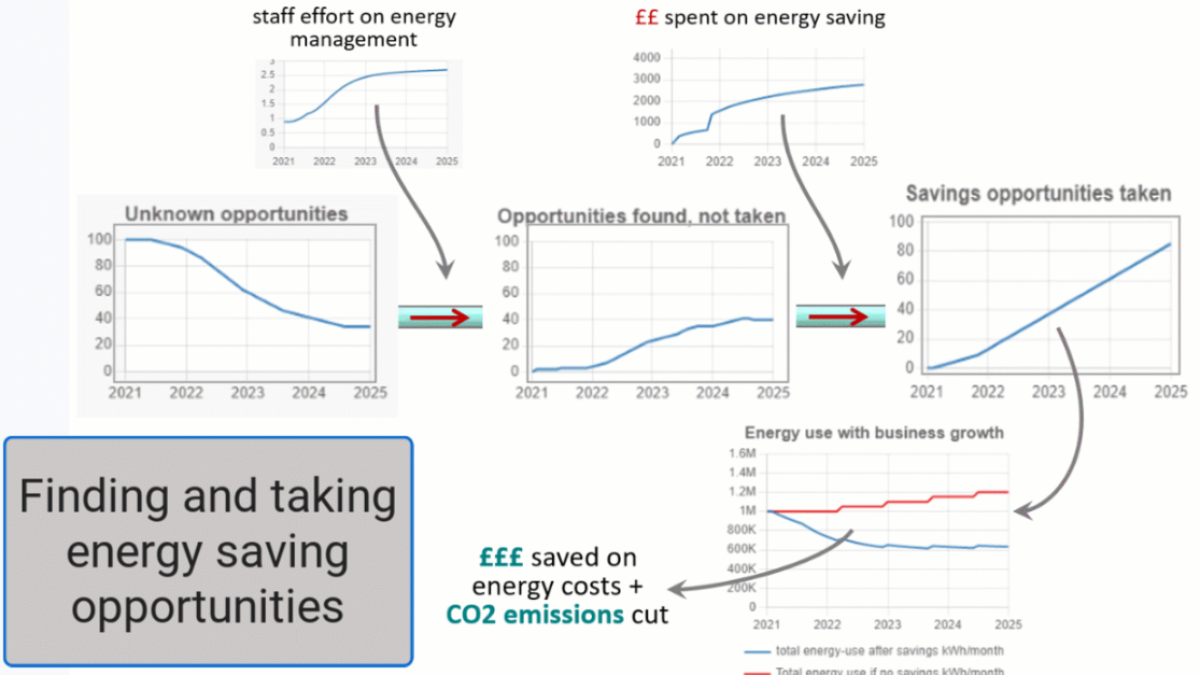
It turns out that such programs follow a generic model for any performance-improvement program:
- We start with an unknown stock of opportunities to make improvements (here, to save energy)
- We put staff effort onto finding and quantifying those opportunities
- We then devote effort and spending to taking those opportunities
- Early savings can then pay for more opportunities to be taken
Here’s that system playing out for a real case …
What are those “opportunities”?
Total energy consumption is driven by energy-using assets. So we can [1] use those assets for less time (switch off not-needed lights and idle equipment), [2] reduce the energy demand for those assets (e.g. insulate), [3] replace assets with more energy-efficient units [4] redesign processes to require less energy [5] out-source processes to more energy-efficient providers.
So that discovery process at left of the model must specify exactly each opportunity-type, and the cost, effort and savings that each offers. But those numbers are path-dependent – you can’t save the same energy twice, so if option X, done first, cuts some energy use by 30%, option Y done later on the same asset can only impact the remaining 70%. Equivalent 'can't make the same improvement twice' issues arise in other PIPs.
There’s more to a successful program …
Most companies are not even scratching the surface of the energy and emissions savings that are possible, but when they do start, there’s a risk that efforts will stall – or fail completely. Why? Evidence suggests two main causes of program failure:
- Leaders’ enthusiasm to achieve the improvements cools as other priorities take their attention.
- Staff engagement with the program has to be built, but quickly fades if there is little visible progress. And, like leaders, other pressures drain their effort.
Of course, having a living model showing how good outcomes will arise, at what scale, into the future, helps build both of these critical “intangibles” and sustain the program’s momentum.
Categories: : business performance, implementation, operations, related course