Soft, intangible business factors are NOT 'qualitative' (71)
 Kim Warren

Intangible factors have scale, change over time and both affect, and are affected by, the rest of the system. We can and do measure and influence them
A McKinsey partner once told me … “We don’t bother with intangibles in our client work – they are undetectable, unmeasurable, and unmanageable“

Our short course explains exactly how intangibles work, both
in reality and in our models. Coupon blog20 for 20% discount.

Get the model of a customer's annoyance (see below).
All 3 remarks are clearly untrue.
- Anyone working in a call-centre can detect when callers are annoyed – anyone eating in a busy restaurant can detect when staff are under too much work pressure – anyone using an app can detect whether it is easy to use – anyone trying to understand some business problem can detect when key data is missing – anyone trying to on-board a new customer can detect the process steps in that task …
- We measure all of these factors and very many equivalent items all the time! You get those ‘how did we do?‘ surveys from call-centres – we know the workload on restaurant staff (meals per hour) – we measure the time it takes app-users to achieve what they need that app to do – we can list and count the number of data-types we need and how many we have … and the same for the steps that any business process needs, and the time for each.
- … and we go to endless effort to manage and improve all these factors – not always with total success, of course, but very often we do OK.
Let’s get the language clear.
So … all these intangible factors, and most others, are not “qualitative”. They can, should be, and often are quantified.
A simple summary of the distinction is something like “Quantitative data is numbers-based, countable, or measurable. Qualitative data is interpretation-based, descriptive, and relating to language.“
I guess most people would think that the word ‘data’ always refers to some numerical measure – like “there are 20 apples in the box“. We would not think, colloquially, that the statement “those apples are red” is ‘data’, but it turns out that – as the distinction above implies – such descriptive, unquantifiable information is indeed ‘data’.
Nevertheless, if we are figuring out, quantitatively, what intangibles do to the behaviour and performance of the business system … and especially if we are modeling that behaviour and performance … then we must be quantifying those intangibles.
SO … when reading about such issues, you might do a global “Find and Replace” to convert the word “qualitative” to “intangible” !
How intangibles relate to other business resources
Followers of my work already know that factors we refer to as business “resources” are more rigorously defined as “asset-stocks” or just “stocks”. They are things that accumulate or deplete over time, like cash in a bank account or water in a tank. They may be strategic (like our customer base or product range) or operational (like outstanding orders or customers waiting). And while some may be good things we want more of, others may be bad things we want less of, like those waiting customers. See more at “What is an asset-stock and why should I care?”
And it turns out that all of the examples I started with, and most similar items are, indeed, asset-stocks – they have some quantity or scale at some point in time, and will be added-to or subtracted-from over the next period to reach a new quantity or scale at the next point in time. Arithmetically, that means:
The intangible quantity today = the intangible quantity yesterday
plus the quantity added since yesterday, minus the quantity lost since yesterday
(Not all intangibles are asset stocks. For example, if service quality reflects only the balance between demand driven by customers (which is a stock) and staff to fulfil that demand (another stock) then that “service quality” is not itself an asset-stock because if either the number of customers falls or staff increase, then service quality immediately changes.)
This figure sets out a rigorous set of definitions for business resource-stocks, including Intangible factors.

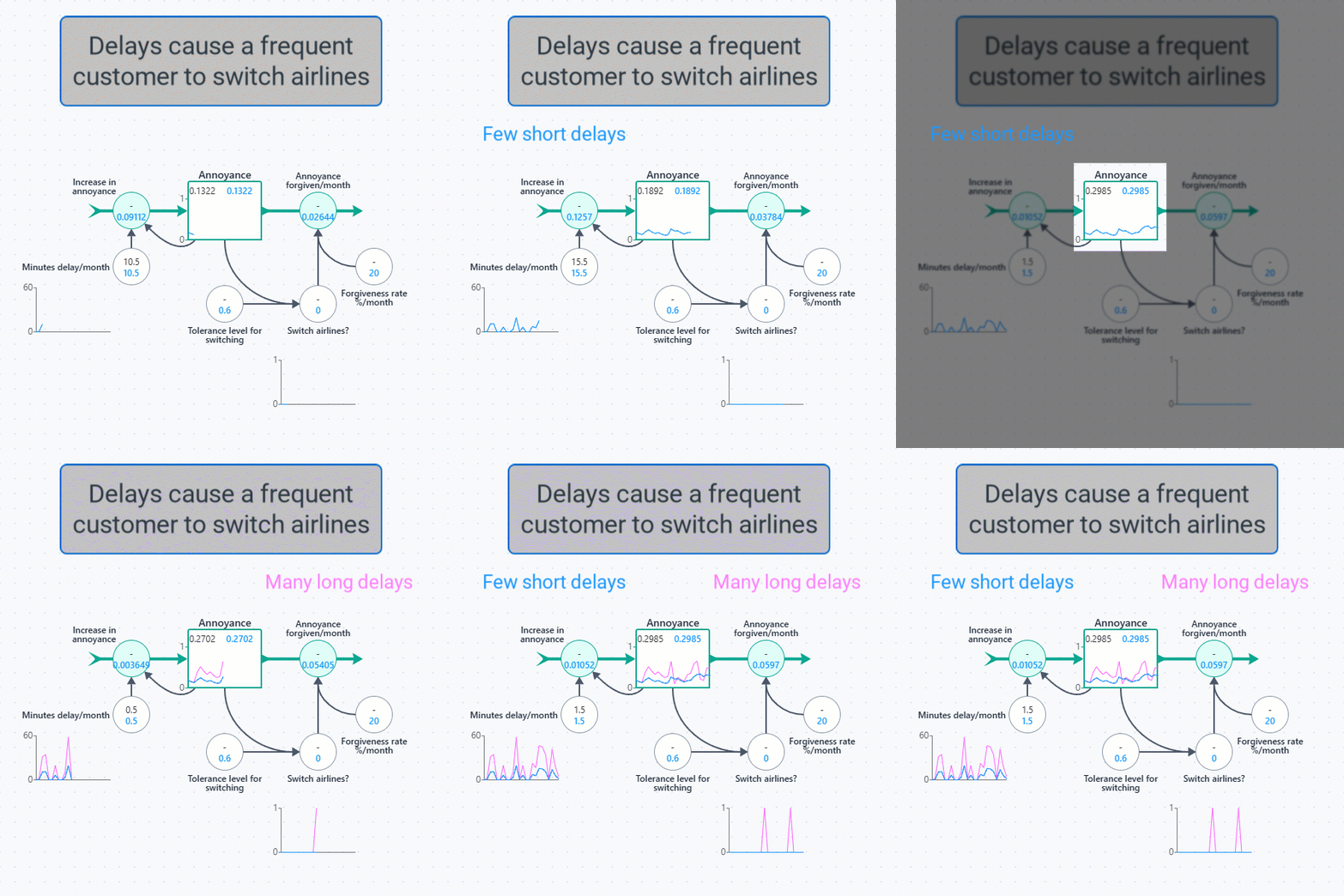
Here's a fun little demo (get the model here) ...
- An airline user flies the same route regularly. They get annoyed by small delays, but gradually forgive them.
- Bigger delays builds up more annoyance (a measurable intangible), until it passes a tolerance threshold and the passenger switches to another airline on the same route.
- Although they start out less annoyed, more long delays build up their annoyance again, making them switch a 2nd time.
Apply this across an organisation's whole customer base and you have a model of delay-driven customer losses.
Categories: : business modeling, related course, model available, strategy